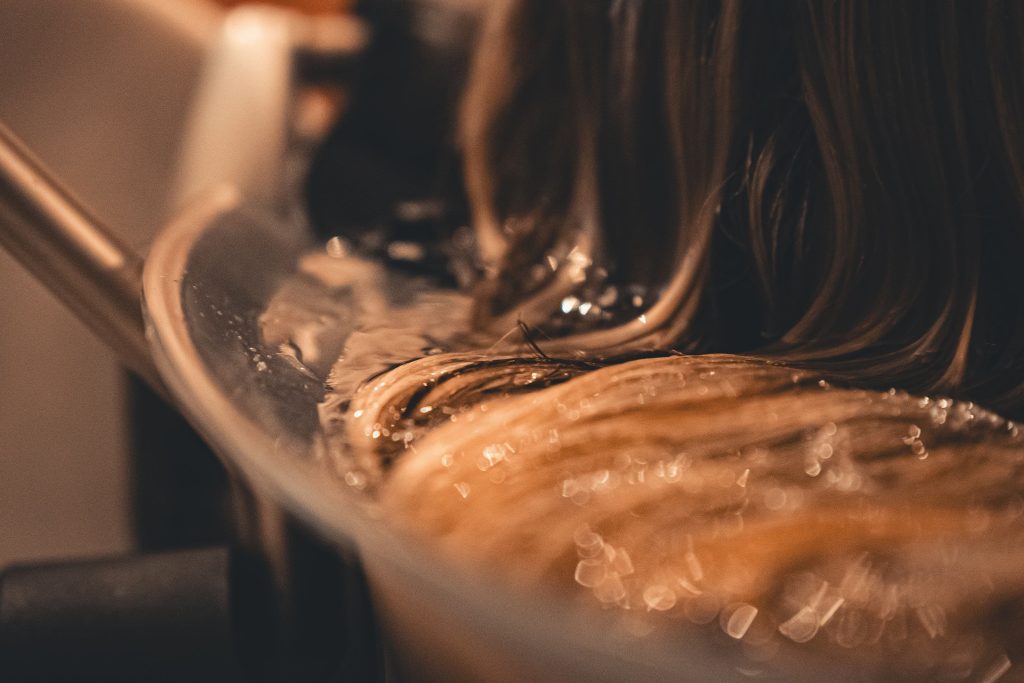
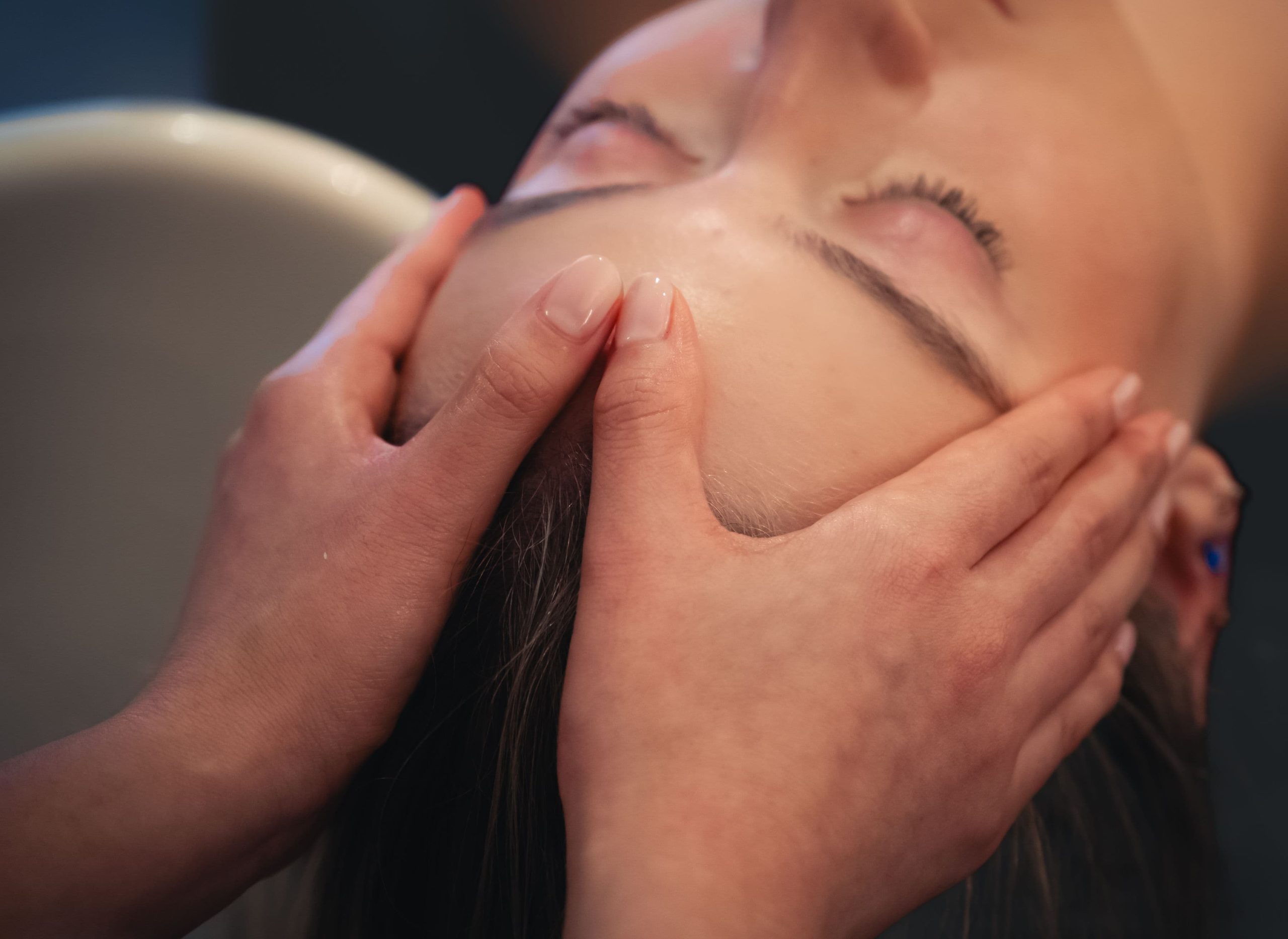
Warm water runs over your scalp. Hands move so slowly you stop following them. Twenty minutes in, you realise you can no longer remember what you were worried about on the drive over.
That isn’t luck, and it’s more than relaxation. It’s what happens when skilled, unhurried touch meets three things most of us never think about: the way your face hangs from your scalp, a set of nerves made for calm, and a scalp that quietly keeps a record of your stress.
In short
A Japanese head spa is an unhurried, multi-step scalp ritual of cleansing, steam, scalp massage and gentle touch, received lying back on a dedicated head spa bed. It works on three levels. The muscle that lifts your brow is anchored into your scalp, so as scalp tension releases, your whole expression softens. Slow stroking switches on nerves wired for calm, and in a small study, regular scalp massage lowered cortisol and blood pressure. And your scalp and hair keep a quiet record of stress, often months after the fact.
Your face
Why do people look different after a head spa?
Because your face hangs from your scalp more than you might think. The frontalis, the muscle that lifts your eyebrows, has no attachment to bone. At the top, it anchors into the galea aponeurotica, a flat, tough sheet of tissue that sits over the skull like a cap and joins your forehead to the back of your head.4
Stress draws that whole system tight. So do screens, squinting and the way you set your brow when you concentrate. Then there is the jaw. The temporalis, one of the main muscles you clench with, fans out beneath the skin of your temples, exactly where a head spa therapist’s hands do some of their most patient work. Even sensation in that part of the scalp travels along a branch of the trigeminal nerve, the same nerve that drives your chewing muscles.
Your scalp is designed to glide over your skull. When the layers beneath it are braced, everything above your eyebrows is braced with them. When they soften, your face follows.
We won’t promise you a facelift. What guests notice in the mirror is quieter than that: a brow that has stopped bracing, eyes that look less tired, a face that seems to have finally exhaled. You haven’t had anything done. You’ve simply had the tension undone.
Four numbers worth knowing
0
Bones your forehead muscle attaches to. It hangs from the sheet of tissue over your skull.4
1-10cm/s
The stroking speed your calm-touch nerves respond to most strongly.2
10weeks
Of twice-weekly scalp massage that significantly lowered cortisol, noradrenaline and blood pressure in one study.1
50-100
Hairs most people shed each day. Stress can push that higher, months after the fact.10
Your brain
What happens in your brain during a head spa?
Your nervous system steps down from high alert. Two things carry it there: a set of nerves made for gentle, unhurried touch, and a measurable drop in stress chemistry with regular scalp massage.
Nerves made for gentle touch
Skin that grows hair is threaded with C-tactile afferents: nerve fibres that barely respond to a firm press, but fire most strongly when the skin is stroked slowly, at around 1 to 10 centimetres per second.2 Their signal bypasses the part of the brain that maps touch and travels instead to the insula, a region involved in how you sense the inside of your own body.3
This is why pace matters more than pressure, and why a hurried head massage can’t do what an unhurried ritual can.
Slow touch isn’t just felt. It’s felt as safety.
The stress chemistry
In a 10-week study of 34 women working office jobs, a 15 or 25 minute scalp massage twice a week significantly lowered cortisol, noradrenaline and blood pressure compared with a group who had none.1 It is a small study, but its findings echo what you feel on the bed: the breath slows, the shoulders drop, the jaw lets go.
The edge of sleep
Many guests fall asleep. Most drift somewhere just before it. Sleep scientists call this light stage N1, the point where the brain’s relaxed alpha rhythm gives way to slower theta waves.5 It is the dreamy, time-bending state you usually pass through in a few minutes on the way to sleep. With warm water, low light and unhurried hands, you get to linger there. If you feel a small jolt as you drift, that is a hypnic jerk, your brain crossing the threshold into sleep.
To be clear, no one has yet published a brainwave study of a Japanese head spa itself. But its ingredients - warmth, darkness, stillness and rhythm - are the textbook conditions for sleep onset.
Your body
Can your scalp show what’s happening in your body?
It can, on a delay. Your hair is a slow-moving record of the past few months. Stress, illness, poor sleep and major life changes often surface on the scalp weeks or months after they happen.
The clearest example is telogen effluvium. A shock to the system sends a wave of hair follicles into their resting phase at once, and weeks or months later they shed together.10 Most people lose 50 to 100 hairs a day. After a demanding stretch, that number can climb, long after the cause has faded from memory.
Even colour is not immune. In 2020, Harvard researchers showed that acute stress in mice activates the fight-or-flight nerves around hair follicles, exhausting the stem cells that produce pigment.6 A year later, a Columbia study that mapped individual human hairs found that greying aligned with stressful periods in people’s lives, and that some hairs regained their colour when the stress eased.7
Circulation at the root matters too. In one small Japanese study of nine healthy men, four minutes a day of scalp massage with a massage device, over 24 weeks, measurably thickened hair, most likely by gently stretching the cells that drive growth.8 It is also why many Japanese head spas use carbonated water, which has been shown to increase blood flow in the skin it touches.9
This is the thinking behind the Japanese scalp-first approach to hair: tend the soil, not just the leaves. A head spa won’t diagnose anything. But when your scalp is cared for regularly, you are far more likely to notice when something changes.
The difference
How a head spa differs from the hairdresser’s basin
Both involve warm water and someone’s hands in your hair. That is where the similarity ends.
| Feature | Japanese head spa | At the hairdresser |
|---|---|---|
| Purpose | Switching off your nervous system while caring for your scalp | Washing your hair before a cut or colour |
| Time | An unhurried hour or more | A few minutes at the basin |
| Position | Lying flat on a dedicated head spa bed | Sitting back in a basin chair |
| Touch | Layered and unhurried, paced for the nerves that signal calm | Quick and functional |
| Setting | A quiet, low-lit sensory room | A busy floor, dryers, conversation |
| You leave | Lighter, clearer, calmer. Softer hair is just the bonus. | With clean hair |
At La Vela
What it feels like at La Vela
You lie back. Warm water flows from a fountain built into the bed itself, over your scalp and away. The walls are Venetian plaster and microcement, the light is low, and the sound is placed so it seems to come from nowhere in particular.
Then the unhurried part begins. Cleanse. Steam. Hands moving at the pace those calm-touch nerves prefer, working the temples, the base of the skull, the line where your forehead meets your hair. Somewhere along the way, you stop keeping track of time.
Every La Vela ritual takes place in a purpose-built sensory room, on a dedicated Yume head spa bed with an integrated water fountain system, using 100% organic products. Nothing is rushed, because the benefit lives in the pace. New to head spa? Begin with the 70-minute Exhale Ritual, or read What Is a Japanese Head Spa? The Complete Guide.
Japanese head spa FAQs
Questions guests often ask
What is a Japanese head spa?
An unhurried, multi-step scalp ritual of cleansing, steam, scalp and head massage and gentle touch, received lying back on a dedicated head spa bed. It is designed to care for your scalp and switch off your nervous system at the same time. For the full picture, read our complete guide.
Is a head spa good for stress?
The research on scalp massage is encouraging. In a small 10-week study, women who received regular scalp massage showed significantly lower cortisol, noradrenaline and blood pressure than a control group (Kim et al., 2016). Most guests describe leaving lighter, clearer and calmer.
Why do people fall asleep during a head spa?
Warmth, low light, stillness and slow, rhythmic touch are the classic conditions for sleep onset: the light stage, N1, where the brain’s relaxed alpha rhythm gives way to slower theta waves. Slow stroking also activates C-tactile nerves, which are linked to feelings of calm and safety.
Can a head spa help my hair?
A head spa deeply cleanses and conditions your scalp, and most guests leave with noticeably softer hair. In a small Japanese study, four minutes a day of device-based scalp massage over 24 weeks measurably increased hair thickness (Koyama et al., 2016). A head spa is not a medical treatment for hair loss, so please see your GP or a dermatologist about sudden or patchy shedding.
How is a Japanese head spa different from a head massage at the hairdresser?
Purpose, pace and position. A hairdresser’s head massage is a few minutes at the basin before a cut or colour. A Japanese head spa is a dedicated ritual of an hour or more, received lying flat on a head spa bed in a quiet room, with touch slowed to work on your nervous system as well as your scalp.
How often should I have a head spa?
There is no fixed rule. The scalp massage studies used regular sessions over weeks or months, which suggests the benefits build with consistency. Many guests return every four to twelve weeks, with gentle scalp care at home in between.
Can men have a Japanese head spa?
Yes. The benefits, from stress relief and scalp comfort to better sleep, aren’t gendered, and you don’t need much hair to feel them. La Vela’s Gentleman’s Ritual is designed around high stress, neck tension and congested scalps.
Can I have a head spa while pregnant?
La Vela’s Bloom Ritual is designed for expectant and new mothers, and is recommended in the first and second trimesters, up to 20 weeks, as our head spa beds require you to lie flat. If you have any medical concerns, please check with your doctor or midwife before booking.
Where can I have a Japanese head spa in Brisbane or the Gold Coast?
La Vela Head Spa has two purpose-built studios: Ashgrove in Brisbane and Palm Beach on the Gold Coast. Both use dedicated Yume head spa beds with integrated water fountain systems and 100% organic products.
Ashgrove · Palm Beach
Feel the difference once
Two purpose-built studios. One unhurried ritual, designed to release what your scalp has been holding and to show you how your hair and face look when that tension finally lets go. When you’re ready, choose your studio.
References
- Kim IH, Kim TY, Ko YW. The effect of a scalp massage on stress hormone, blood pressure, and heart rate of healthy female. Journal of Physical Therapy Science. 2016;28(10):2703-2707. PubMed
- Löken LS, Wessberg J, Morrison I, McGlone F, Olausson H. Coding of pleasant touch by unmyelinated afferents in humans. Nature Neuroscience. 2009;12(5):547-548. PubMed
- Olausson H, Lamarre Y, Backlund H, et al. Unmyelinated tactile afferents signal touch and project to insular cortex. Nature Neuroscience. 2002;5(9):900-904. DOI
- Pessino K, Patel J, Patel BC. Anatomy, Head and Neck; Frontalis Muscle. StatPearls. NCBI Bookshelf
- Patel AK, Reddy V, Shumway KR, Araujo JF. Physiology, Sleep Stages. StatPearls. NCBI Bookshelf
- Zhang B, Ma S, Rachmin I, et al. Hyperactivation of sympathetic nerves drives depletion of melanocyte stem cells. Nature. 2020;577:676-681. PubMed
- Rosenberg AM, Rausser S, Ren J, et al. Quantitative mapping of human hair greying and reversal in relation to life stress. eLife. 2021;10:e67437. eLife
- Koyama T, Kobayashi K, Hama T, Murakami K, Ogawa R. Standardized scalp massage results in increased hair thickness by inducing stretching forces to dermal papilla cells in the subcutaneous tissue. Eplasty. 2016;16:e8. PMC
- Morimoto Y, Tanabe Y, Hori T, et al. Influence on the sweating function by the successive application of artificial CO2 bath salts. The Journal of Balneology, Climatology and Physical Medicine. 2020;83(2). J-STAGE
- American Academy of Dermatology. Hair shedding. aad.org
This article is general information, not medical advice. If you’re worried about hair loss, headaches or your health, please speak with your GP.